Company announcement · September 2026
The William D. Dorland Prize
In memory of Professor William (Bill) Dorland, Lanyon AI has contributed to the permanent endowment of the William D. Dorland Prize in Computational Plasma Physics.
The American Physical Society (APS) has recently established the William D. Dorland Prize in Computational Plasma Physics, and Lanyon AI is one of the organizations supporting the permanent endowment of this prize. Bill Dorland was a dear friend and colleague to Chief Scientist Jimmy Juno and Chief Technology Officer Ammar Hakim. Bill supervised Jimmy’s PhD thesis at the University of Maryland (UMD) and served as the department head of the Princeton Plasma Physics Laboratory’s (PPPL) Computational Sciences Department while Ammar was the deputy head and Jimmy was a staff research physicist in the department. His passing has left a large personal and professional vacuum in our lives, and his wit, kindness, and stalwart support for computational plasma physics are missed regularly.
The prize will recognize: “Outstanding contributions in computational plasma physics, broadly interpreted and encompassing fusion, astrophysical, and all other areas of the subject; including significant advances in physical understanding and predictive capability achieved, wholly or in part, through computational methods, and/or the development of transformative numerical techniques enabling such advances.” (APS website).
In recognition of Bill’s profound impact on the lives of Jimmy and Ammar, Jimmy will reflect on his time as Bill’s PhD student, as well as the intellectual continuity to what we are building here at Lanyon from both Bill’s nurturing of us as scientists and the values he instilled in us on the construction of trustworthy, verified simulations.
A Deep Dive into the Distribution Function: Pushing the Frontier of Continuum Kinetic Simulations with Bill
I arrived at UMD in the summer of 2014 as many over-eager graduate students do, anxious to dive into research and determined to find a research group which would immediately hire me. This enthusiasm stemmed from an early awareness I had about my interests in computational plasma physics: software development is hard; it takes time. While culturally, computation has often been associated with the theoretical side of physics, the building of computational tools has a lot more in common with the work done by our experimental colleagues. Experience in building scientific software is hard-won, and the number of folks thinking carefully about how to build sustainable software that can be adapted to diverse problems and push the frontiers of physics is much smaller than the number of folks developing one-off tools to answer targeted questions.
I immediately gravitated towards Bill; the stories I had heard and read about Bill very quickly convinced me that not only did I want to do my thesis with Bill, if I had any control over it, I wanted to someday be Bill. Here was someone who had built a vast career off of creating production plasma physics software, used across the entire field, and his near endless deep knowledge of all parts of plasma physics was inspiring. Funnily enough, although I did not know it at the time, Bill had been interviewing me when I first met him at the previous fall’s APS Division of Plasma Physics meeting when he stopped by my poster to ask questions about the research I had done as an intern at PPPL (with Ammar!). That was Bill. Simultaneously incisive and warm. Probing the limits of my knowledge in an utterly disarming way so that, instead of being nervous in the face of a senior scientist, the whole conversation felt effortless. All the while, Bill’s sense of humor came through strongly in teasing me for doing a very-undergraduate thing in poster preparation: I had misinterpreted the poster board is 4’ x 8’ to mean we were required to make a 4’ x 8’ poster, “the biggest freaking poster I’ve ever seen” in Bill’s words.
Bill took me on as a student early, on the condition that I at least do some work as a teaching assistant (a half teaching assistant/half research assistant position). That was Bill. UMD was fortunate at the time to have significant resources for supporting the plasma physics graduate students, but Bill valued teaching, often taking teaching assignments (when he wasn’t running the Honors College!), such as physics for pre-med students, that require the hard work of inspiring the students in equal measure to clearly communicating the science. He wanted his students to see their roles in academia not just as a privilege to work on cutting edge problems, but as a responsibility to serve the next generation. During this time, I had the opportunity to assist him and two other faculty at UMD on the creation of a new course: “HONR 268N: Unlocking the Mysteries of the Universe with the Computer,” designed for freshmen in the Honors College to give them early exposure to computational physics. In many respects, the ideas that underpinned the structure of this course inform a grand vision we have here at Lanyon for how Lanyon can be a new tool in education. We envision a world where, in the same way this course set the task to the students of “find the Higgs in this LHC data” and then spent the semester giving the students the tools to do just that, Lanyon provides the foundation for a variety of computational coursework in which verified solvers can be used to validate physical intuition about the world, from the electromagnetic fields around compact objects to supersonic flow around obstacles.
When I dove into research at UMD under Bill’s supervision, I found myself in a uniquely collaborative environment, gaining a co-advisor and continued close collaborator Jason TenBarge, who, alongside Bill, pitched an early project in understanding the dissipation of plasma at microscopic scales based on my simultaneous physics interest in turbulence and computational interest in algorithm development. This project of studying driven plasma turbulence in a particle-in-cell code, and the challenges encountered in the type of analysis we were attempting, very quickly inspired me to reach out to Ammar about collaborating on a new kind of numerical solver for the kinetic equation. Bill was initially skeptical even if the idea was philosophically similar to the breakthroughs he had led in numerical solutions to the gyrokinetic equation. Instead of discretizing the particle distribution function in terms of particles, and thus having to contend with the Poisson noise inherent to all Monte Carlo methods, we could directly discretize the kinetic equation and solve a high-dimensional PDE. The journey to what are often called “continuum” codes for gyrokinetics had been a long one, and in the early discussions on the idea Bill repeated the refrain “it was hard enough for us to do this in 5D, and now you’re talking about doing full 6D?”
Those early days stretched into the first years of my graduate work; Bill, Ammar, Jason, and me all bouncing off each other at the intersection of plasma physics, applied mathematics, and high-performance computing. The problem was hard. There was a reason outside of a few small test codes in the applied mathematics community in one spatial dimension and one velocity dimension, no one had really made a breakthrough on the full 6D Vlasov-Maxwell system of equations with a continuum kinetic approach. Bill would later tell me that there were moments he genuinely did not think what I was doing would work but that “it was good you did not listen to me on this front” with a big grin. But that was Bill. Bill was very comfortable taking big swings and he loved living at the frontier, even if the frontier was messy and uncertain. Bill was writing CUDA code at least a decade, if not more, before the rest of the plasma physics community, happy to opine about how GPUs were going to take over the world while many of us were just trying to squeeze performance out of Intel’s failed competitors like the Knight’s Landing many-core architecture. While I was glad to push back on Bill’s skepticism of making 6D Vlasov work (and that skepticism forced a variety of innovations that formed the core of later algorithmic developments), I do regret not listening to Bill more on the GPU programming front and waiting so long to port that Vlasov solver to GPUs.
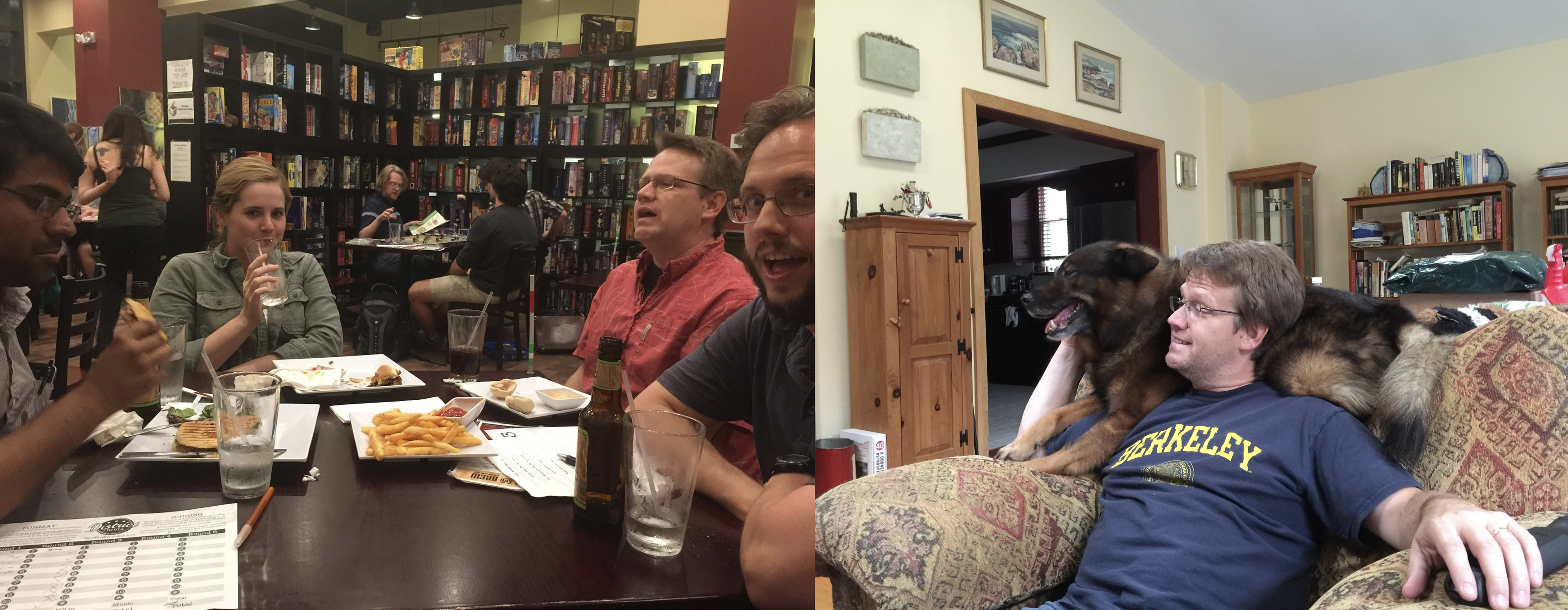
Bill’s support spanned all components of the project, from technical to logistical to personal. We would have a meeting about progress and then he would join the plasma group for pub trivia at a board game cafe that was a frequent haunt of our cohort (and where I ultimately wrote a sizable percentage of my thesis!). He would send emails helping me coordinate my visiting graduate student appointment at PPPL and inviting me to Thanksgiving with his family. He would bear extra logistics I would sometimes accidentally hoist on him with a laugh, like when I became one of the first students at UMD to defend his PhD during Covid (having scheduled the defense months earlier), leading UMD to request extra paperwork and meetings to ask Bill “so how did this ‘Zoom defense’ thing go?”. As I transitioned from a PhD student to a postdoc and later a staff research physicist at PPPL, Bill remained a mentor, collaborator, and friend. Many of my closest collaborations were fostered under Bill’s continued guidance and advocacy for my work. As grid-based Vlasov solvers find new applications in high energy astrophysics, I think about how Bill connected people, like my close collaboration with Sasha Phillipov at Stanford, and the work Sasha and I have done together on problems where a grid-based Vlasov approach genuinely solves long-standing challenges with Poisson noise for plasma problems relevant for pulsar (neutron star) observations. Bill’s steadfast presence in my, and many others, lives is missed regularly.
When I look back on my time working with Bill and all of his extended collaboration network, I think that what made Bill such a force in the community was his ability to apply his deep computational knowledge so broadly and so carefully. Bill was never one to be satisfied with how a given piece of code was written if he thought it could be made faster, more accurate, more meticulously tested. I have distinct memories of him interrogating the breakthroughs in conservative discretizations of the Vlasov equation and whether we could prove not only that total energy was conserved, but whether that energy was going to the right places as it was exchanged between the plasma and the electromagnetic fields, and even the different degrees of freedom within the plasma. When, very soon, Lanyon can autonomously recreate and verify the entirety of my thesis by generating a provably $L^2$ stable, energy conserving discontinuous Galerkin discretization of the Vlasov-Maxwell system of equations within our DSL, I will think about the uncountable hours spent with Bill on this endeavor. I will think about how we went from, in less than a decade, “this seems impossible” to people being able to generate their own version of these breakthroughs with simple prompts to Lanyon. If Lanyon is the distillation of the collective computational physics and applied mathematics experience of our team, it carries with it the legacy of people like Bill who instilled in us these experiences and our larger values. These very human experiences, the sweat and tears and if we are honest a bit of blood that goes into the development of these breakthroughs and people like Bill who guide us along the way, are what make Lanyon what it is. I am honored we can pay at least a small tribute to Bill’s memory to permanently endow this fellowship in his name.