
Research note · Physics deep dives
Why is Fusion Hard? A Physicist’s Perspective on Always Being 10 Years Away
In this physics deep dive we use Lanyon to reveal what is so hard about sustained nuclear fusion and the physics behind the ongoing quest to bottle a star.
Nuclear fusion is often described as the holy grail of clean energy. Yet despite fusion’s widespread prevalence in science fiction as the natural evolution of how we satisfy our energy needs, the common refrain of “holy grail” in clean energy is equally a tongue-in-cheek joke for our quest for fusion; a quest which seemingly continues ad infinitum with the general public aware that fusion is always 10 (or 20, or 30) years away. Lanyon’s neurosymbolic architecture represents the perfect tool for analyzing these difficulties, and their potential solutions, by allowing us to combine the trustworthiness of formally verified numerical simulations with the flexibility of AI-driven physics analysis. So in this first in a series of deep dives into physics, we use Lanyon to investigate this question: why is nuclear fusion so hard?
Bottling a star
There are many reasons fusion has earned this reputation as an endless endeavor. The fuel is often called abundant when the most energetically favorable (i.e., the easiest) fusion reaction, deuterium-tritium fusion, only has half of its ingredients readily available, and one must solve a non-trivial manufacturing problem to breed tritium on site at the power plant using a combination of lithium and the high energy neutrons produced by the fusion reaction. The reaction is described as safe compared to fission in the sense that the radioactive byproducts decay in human lifetimes, instead of requiring us to come up with messages for distant descendants to not dig wherever we bury the fissile waste, but safe compared to fission is not always considered good enough for a public still wary of nuclear energy. And the economics have posed a consistent challenge. A fusion power plant inherits all the complexity of a fission plant (a steam turbine with an exotic boiler) plus additional engineering challenges with cryogenics for magnets, tritium breeding blankets, and a first wall that needs replacing after it has received sufficient neutron damage, in a market where solar and batteries are getting continually cheaper and small modular reactors promise firm power with a simpler core.
Many of these challenges would yield to increased support and funding. Solar became more efficient and small modular reactors achieved criticality with the hard work of many smart people, just as progress in the fusion sciences on optimized blanket design and new magnet technologies has accelerated in recent years. And yet, fusion retains its reputation as a breakthrough just out of reach.
As part of this series of deep dives into computational physics and engineering, we will use Lanyon to examine what is arguably the single underlying reason fusion is so hard: the ways the plasma physics forbids easy solutions and has forced us to continuously iterate. My claim as a physicist is that “10 years away” was the genuine honest estimate every time it was made. At each stage there was a concrete physics problem in confining a super-hot plasma and shaping it to maximize fusion gain, a credible plan for solving said problem, and a reasonable hope that once this problem was solved, only optimization would remain. And yet each generation ran into new physics that pushed fusion further out; every solution revealed new instabilities on slower timescales or smaller length scales, an onion of problems that could only be peeled one layer at a time. As we will see, Lanyon provides the ideal platform for peeling back this onion. Lanyon’s neurosymbolic architecture generates powerful numerical solvers, reliably, through its deterministic symbolic layer, while simultaneously the neural layer gives us tremendous flexibility to autonomously analyze these simulations in great detail, revealing precisely why the physics of fusion has remained so untamed.
We begin with the first and most immediate physics challenge in fusion: getting nuclei to fuse at all. Achieving fusion requires high enough temperatures so that the deuterium and tritium fuel can overcome the repulsive Coulomb barrier and the strong force can take over, the deuterium and tritium can fuse, and a 3.5 MeV alpha (ionized Helium) particle and a 14.1 MeV neutron are produced. The alpha particles stay in the fuel and sustain the fusion reaction; the neutrons escape and give their energy to the boiler. At the temperatures required to even get a useful rate of quantum tunneling through the Coulomb barrier, over 100 million degrees (or if you’re a plasma physicist, about 10 kiloelectron volts, keV, since we like to absorb Boltzmann’s constant into our temperature definition), the deuterium and tritium are stripped of their electrons and our fuel ionizes into a plasma.
At these temperatures, no material can hold the resulting fusion reaction. It is not that anything dramatic occurs; here, we see the argument for the safety of fusion: the plasma erodes whatever surface is trying to contain it like a river eating away at its bank. The atoms knocked loose by this scouring of the surface quickly shut off the fusion reaction. Any heavy ions from our choice of surface material, like tungsten, pollute the fuel and then cool it through the same physics that lets astronomers read the composition of distant stars: the plasma gives its energy to the heavy ions and these ions radiate their energy away as light. The fusion reaction is simply snuffed out.
Of course, while it is incredibly useful that fusion has no chain reaction and no meltdown risk, this same fragility raises the fundamental question of fusion physics: how do we get more energy out of the plasma than we put in? The give and take between how fast the plasma loses its energy, and how fast fusion can put energy back into the plasma, is contained in the Lawson criterion,
$$ n\tau_E \;\gtrsim\; 1.5\times10^{20}\ \mathrm{s\,m^{-3}}. $$This criterion is a threshold for a fusion reaction to be self-sustaining; the plasma density of equal parts deuterium and tritium $n$, and the energy confinement time $\tau_E$, when combined together must be large enough that the heating from the produced alpha particles exceeds all of the losses the plasma is experiencing. Contained in the right hand side of the criterion is a function of temperature1 so we can visualize ignition by plotting the Lawson criterion as a function of temperature.
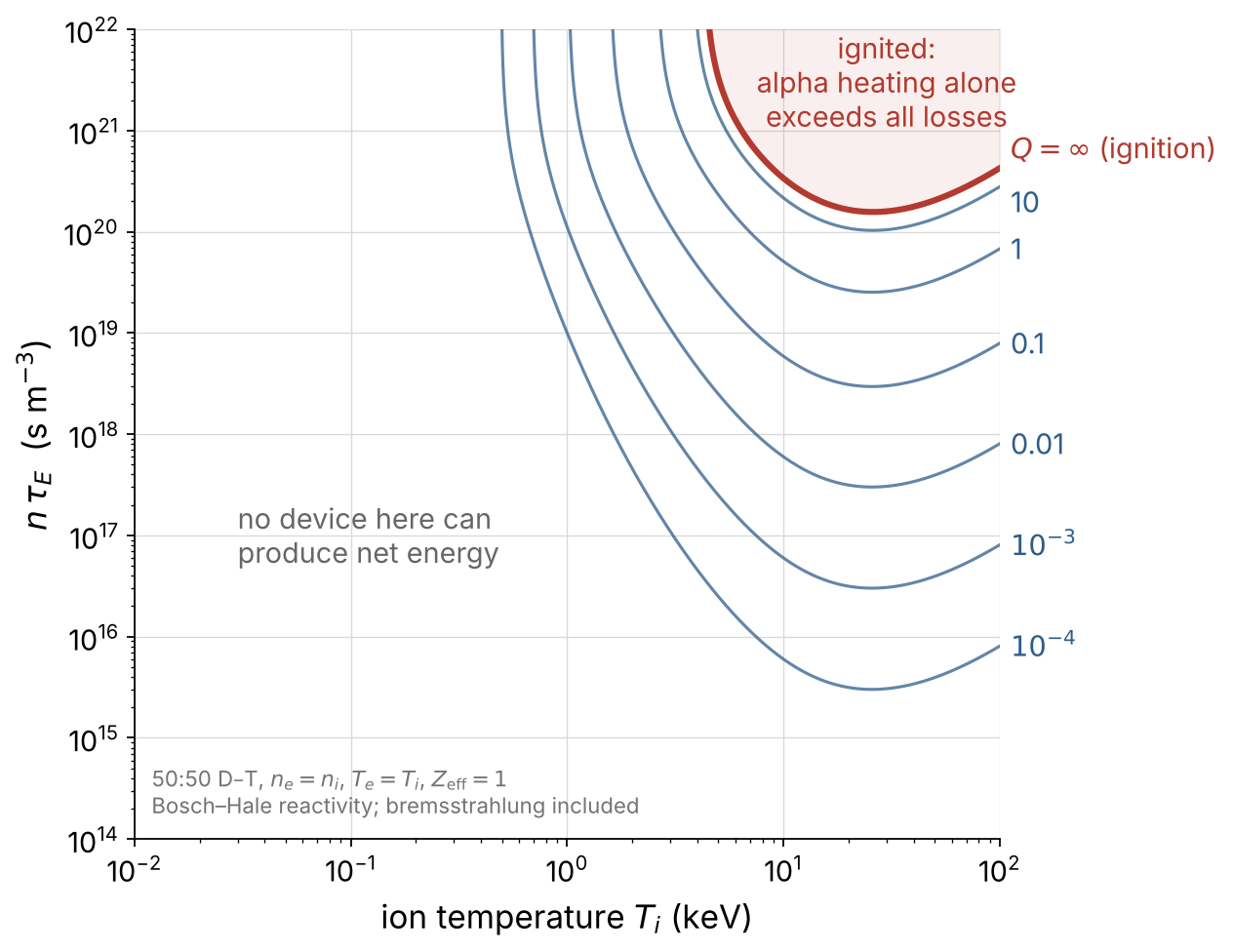
Different configurations of fusion reactors operate at different densities, but regardless the Lawson criterion sets a requirement for each concept. If the configuration has density $10^{20}/m^3$, the energy confinement time must be at least one second, if the configuration has higher density, say $10^{24}/m^3$, the energy confinement time must be hundreds of microseconds, and so on. Ultimately though, plasma physics decides the energy confinement time we get, and if regular material confinement will not work, how do we push in the correct direction to achieve fusion?
Manipulating the plasma with magnetic fields
We have another tool in our toolbox for manipulating a plasma compared to a liquid or gas: the fundamental forces of electricity and magnetism. The fact that our fuel is a mixture of positively charged ions and negatively charged electrons means that we do not have to rely on just a vessel to contain the fusion reaction, we can manipulate that plasma via electric and magnetic fields. Magnetic fields in particular would seem ideally suited for such an endeavor: the force the plasma experiences due to a magnetic field is by construction confining perpendicular to the magnetic field; particles do not want to move across magnetic field lines, they want to orbit around those field lines. For electrons and ions, these orbits can be quite small in even modest magnetic field strengths, and thus the particles are effectively tied to the magnetic field, be it externally produced or self-imposed.
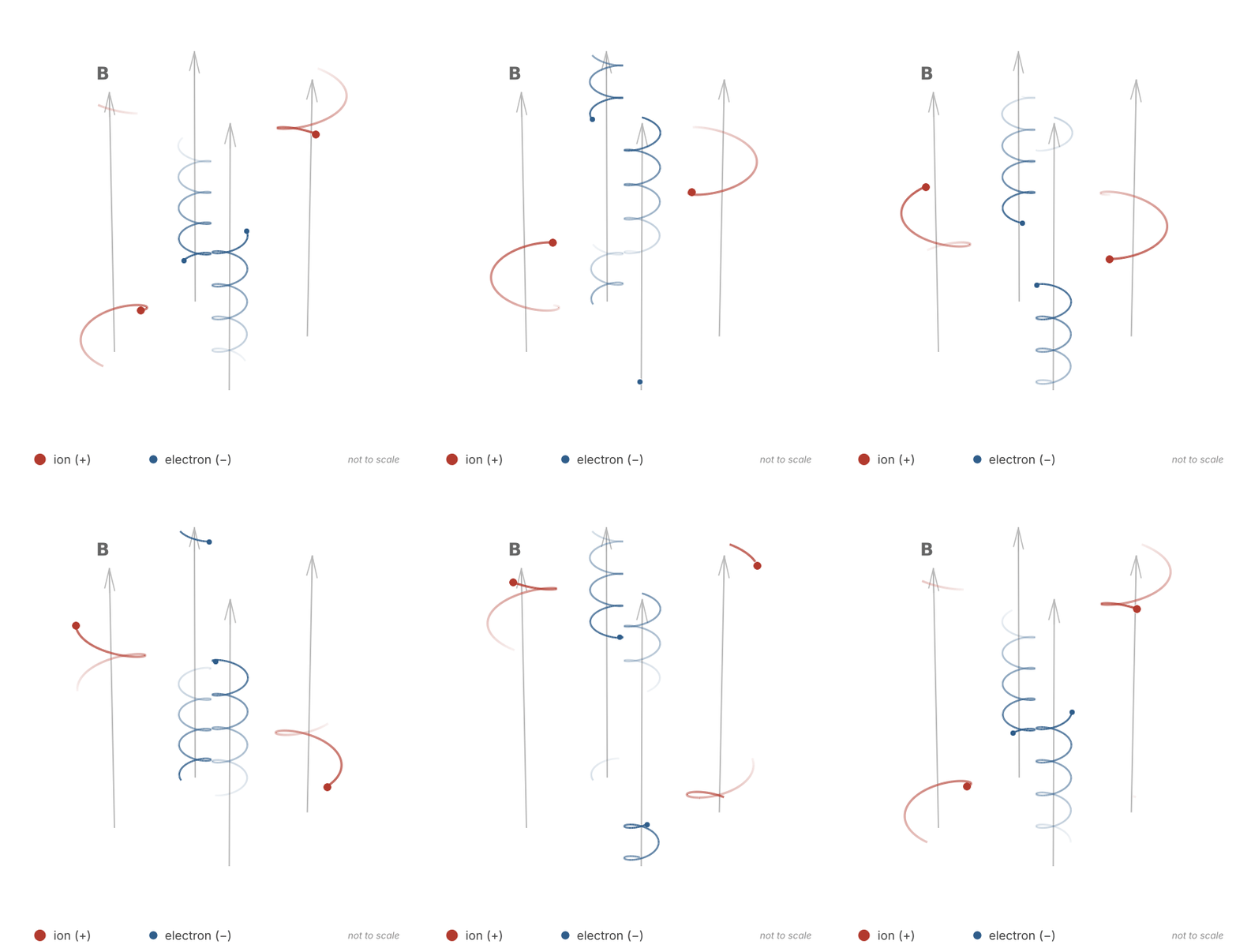
While the visualization of the particle gyromotion about the magnetic field shows the particles are still free to move along field lines, it is worth considering before introducing any geometric complexity or shaping of the magnetic field what would happen if we were now following not just a handful of particles, but a large density of plasma. The particles are tied to the field, but with enough plasma density the field is likewise tied to the particles; the fundamental system of equations is that of magnetohydrodynamics.
$$ \begin{align} & \frac{\partial\rho}{\partial t} + \nabla\cdot(\rho\mathbf{u}) = 0, \\ & \frac{\partial}{\partial t}(\rho\mathbf{u}) + \nabla\cdot \left [\rho\mathbf{u}\otimes\mathbf{u} + \left(p + \frac{|\mathbf{B}|^2}{2\mu_0} \right)\mathbf{g} -\frac{1}{\mu_0} \mathbf{B}\otimes\mathbf{B} \right ] = 0, \\ & \frac{\partial \mathcal{E}}{\partial t} + \nabla\cdot \left[ \left (\mathcal{E}+p + \frac{|\mathbf{B}|^2}{2\mu_0} \right )\mathbf{u} - \frac{1}{\mu_0}(\mathbf{u}\cdot\mathbf{B})\mathbf{B} \right] = 0, \\ & \frac{\partial\mathbf{B}}{\partial t} - \nabla\times \left [\mathbf{u} \times \mathbf{B} \right ] = 0 \end{align} $$In this fully expanded form, we can see that the effective pressure in the plasma is not simply $p$, but includes a contribution from the magnetic field, $|\mathbf{B}|^2/2\mu_0$. Thus, in the same way we can imagine compressing a gas by applying pressure, increasing the density and temperature of the gas via this compression, we can likewise imagine utilizing a magnetic field to compactify our plasma and achieve the densities and temperatures needed for fusion. Not only does the magnetic field push on the plasma, the field also resists being bent via the tension force proportional to $\nabla\cdot\mathbf{B}\otimes\mathbf{B}$. Thus, our earlier visualization of cyclotron motion suggests such compression of the plasma should be relatively straightforward since the plasma does not want to move across magnetic field lines. But can we confine the energy long enough to achieve fusion compressing a plasma with a magnetic field?
Pinching the plasma
The simplest application of this idea: drive a large current through the plasma. Any current wraps itself in circular magnetic field lines. The stronger the current, the more these field lines will want to contract from their inherent tension like a stretched rubber band, and their contraction will apply pressure on the plasma compressing the plasma inward. The plasma is acting like a very large number of current carrying wires that then all attract towards each other.
Easy enough right? At first glance, perfect! The same current that squeezes the plasma also heats it, and no external magnets are required. When the inward squeeze balances the plasma’s outward pressure, the column sits in equilibrium, known as the Bennett relation:
$$ \frac{\mu_0 I^2}{8\pi} = n \pi a^2\,(T_e + T_i), $$where $I$ is the current and $a$ is the radius of the column. Now immediately we can connect this relation back to the Lawson criterion. If we want more density and hotter plasma, we just need more current. Early studies of lightning strikes captured this pinch effect dramatically with the compression of copper tubes2. For a column a millimeter in radius we would require about half a million amps to achieve the needed densities and temperatures for fusion, a lot, but eminently achievable. So achievable that this idea of the Z-pinch (named for the direction of the flow of the current in a cylindrical vacuum chamber) was one of the first fusion concepts ever explored.
In the early days of the fusion program, a variety of labs built Z-pinches, excited at the prospect of straightforward fusion energy from a simple linear device. And the first devices measured neutrons! But relatively quickly folks figured out there was nothing but bad news in the data; these were not thermonuclear neutrons, neutrons produced by sustained fusion, but transient neutrons produced at the end of the discharge, in a seemingly preferential direction along the axial direction, in too great a number for the measured temperatures3. What happened? Lanyon can show us:
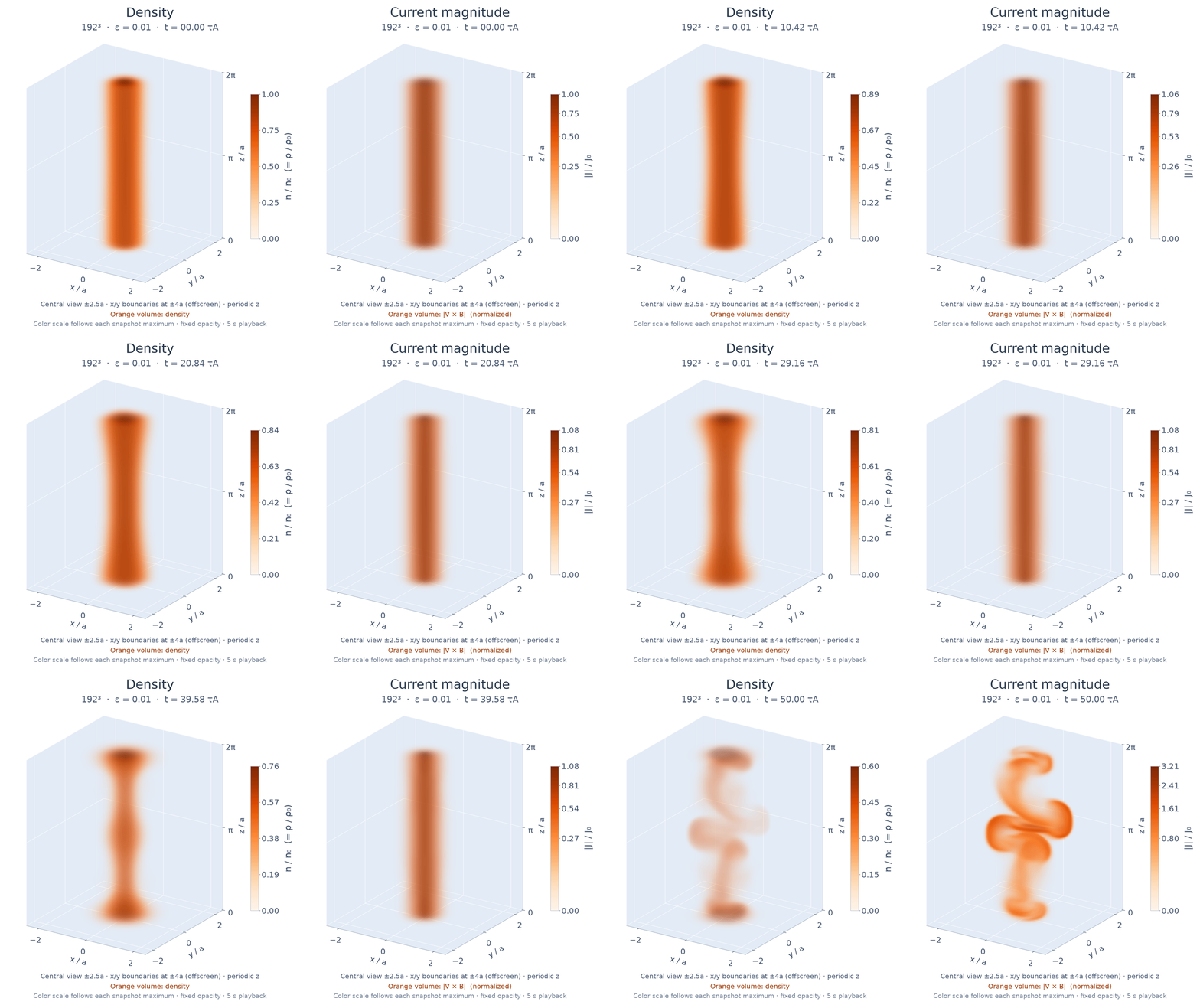
By specifying with Lanyon a three-dimensional MHD solver with hyperbolic divergence cleaning, and using Lanyon’s /simulate command to setup an initial pinch equilibrium with a corresponding perturbation to that equilibrium, we see Lanyon’s generated MHD solver producing the first instability that killed the Z-pinch: the sausage instability. Unfortunately for fusion physicists, a pinch equilibrium is not an equilibrium like a pencil lying flat on a desk, which rocks back into place when you nudge it, but that same pencil balanced precariously on its point; any little nudge leads to a quick disintegration of the plasma column. And quick here is very fast, much faster than the time scale we need by the Lawson criterion. The relevant time scale for these instabilities is the amount of time it takes an Alfvén wave to propagate radially in the column, often referred to as the Alfvén crossing time. For Z-pinches running the needed current and operating at the desired densities, this time scale is nanoseconds. Even in the most ambitious cases where we can operate the Z-pinch at high densities, $10^{24}/m^3$, these instabilities are orders of magnitude faster than the needed energy confinement time of hundreds of microseconds.
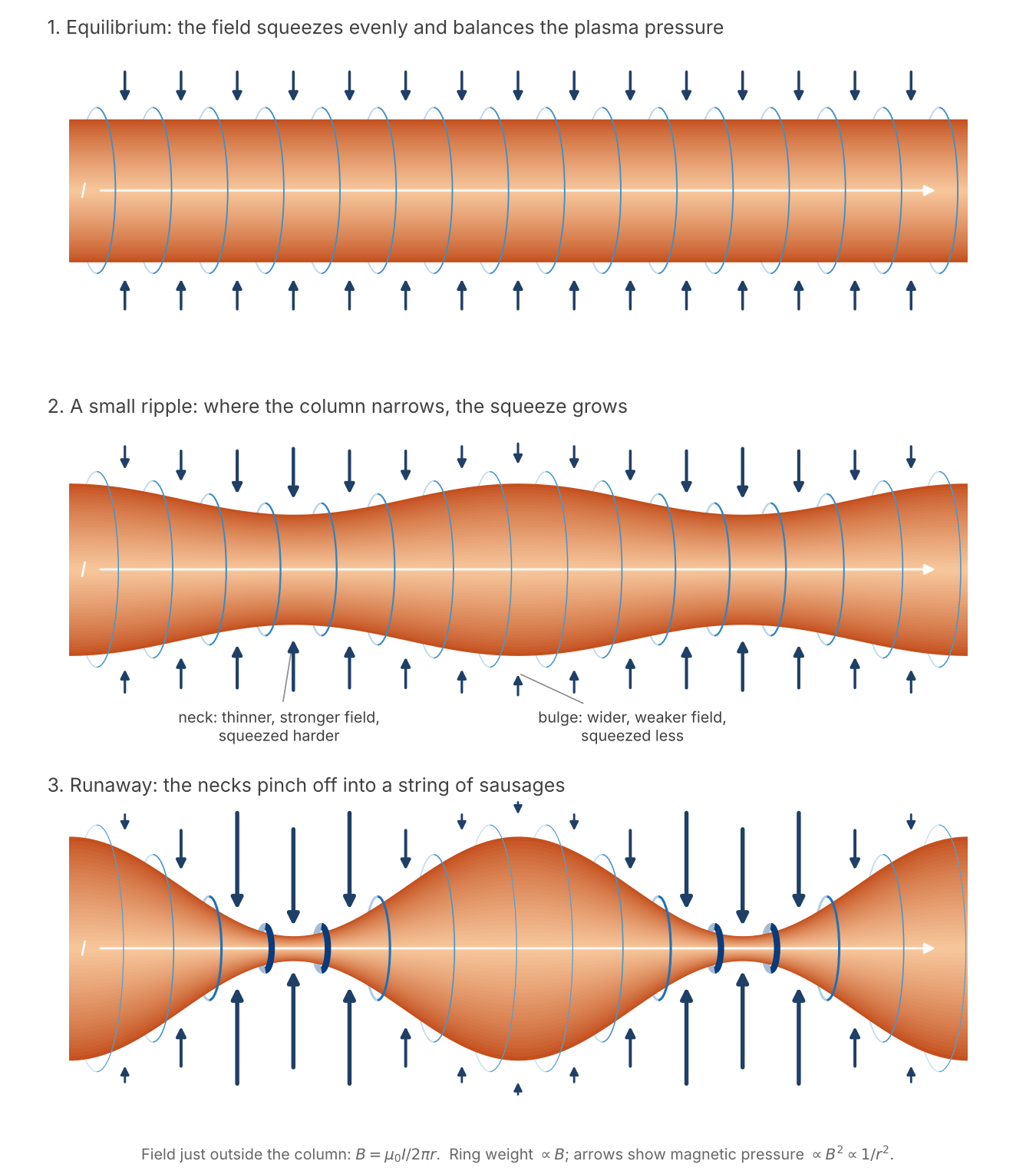
What is happening in this setup? Why is the plasma so violently unstable? To understand this first hurdle in the history of fusion, we need to take a closer look at the equilibrium which arises in a pinch configuration. While we start uniform, with magnetic pressure balancing plasma pressure everywhere, and from the Bennett relation a nice mechanism for pushing up and to the right in the Lawson criterion by driving more current and getting more pressure, there is an issue the moment there is any imperfection in the axial plasma column. The second this disturbance manifests, suddenly the magnetic pressure is larger in some regions and smaller in others, and as the plasma pinches non-uniformly, the feedback loop grows, leading to a necking of the plasma like a ductile material locally thinning under tension (since it is the magnetic tension locally pinching the field). The result is a plasma column that looks less like a nice cylinder of fusing plasma and more like a long string of sausage links4.
Indeed, not only can Lanyon visualize the plasma evolution and show the destabilization of the plasma column, the neural part of the neurosymbolic architecture accepts specific diagnostic requests, allowing us to clearly identify the modes that are growing. In requesting this linear analysis, the neural component adds to the simulation driver a time series of different radial velocity harmonics, performing a spectral expansion on the grid of the radial velocity in azimuthal and axial modes.
$$ C_{mn}(t) = \frac{1}{v_A^{r=1}}\frac{\sum_{r\le 2} w v_r e^{-i(m\theta + n z)}}{\sum_{r\le 2} w} \qquad w = e^{-r^2}\Delta x \Delta y \Delta z\qquad v_r = \frac{x v_x + y v_y}{r} $$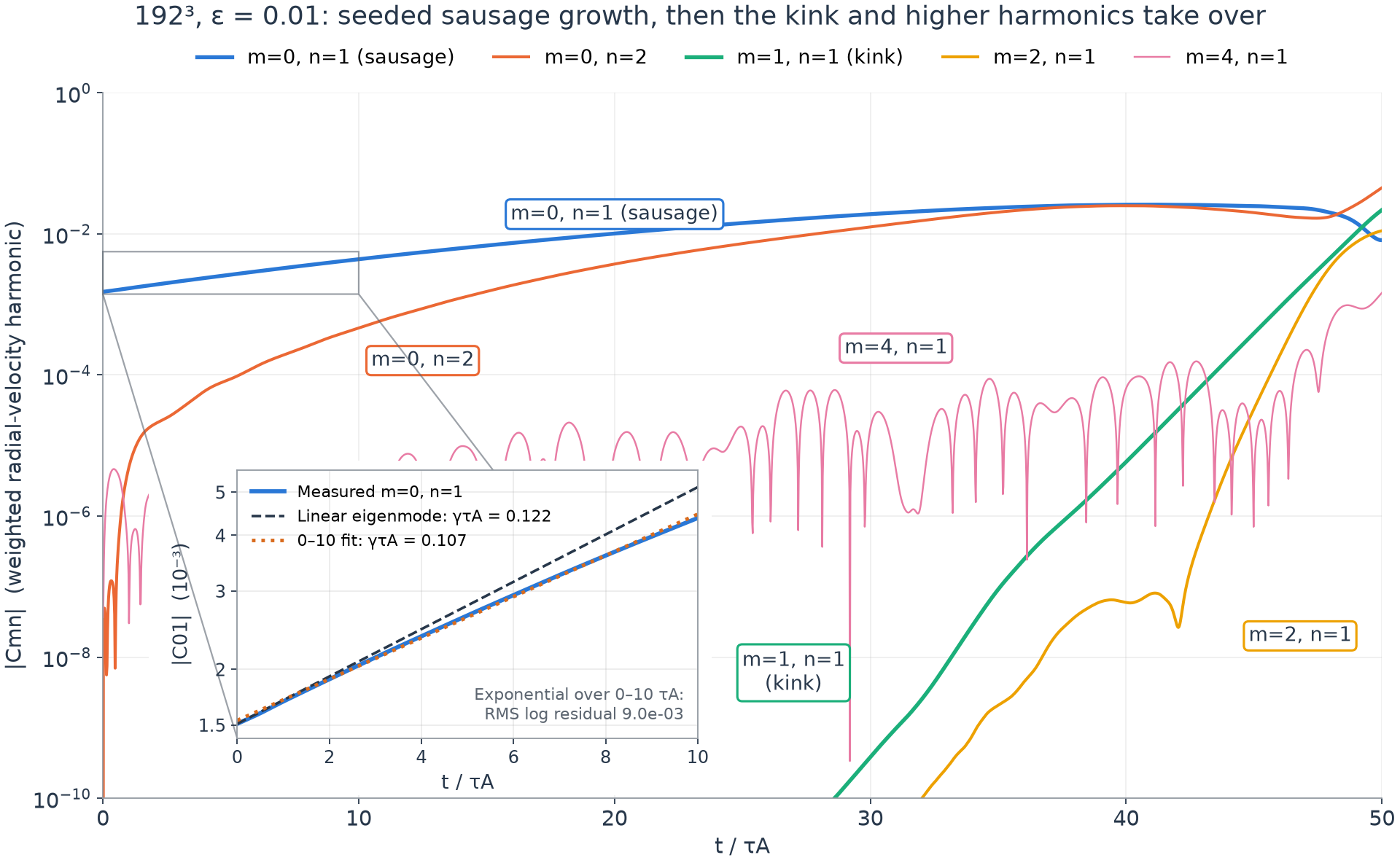
In this regard, the utility of a neurosymbolic architecture is made manifest: we can construct high-quality solvers reliably and consistently for complex systems from the symbolic component, while autonomously generate non-trivial initial conditions (like precise equilibrium with physically consistent perturbations) alongside sophisticated diagnostics for determining the physics from the neural component. Consistent with the history of the Z-pinch, the axisymmetric, $m=0$ sausage instability grows first, and then the whole plasma column evaporates as other instabilities such as the non-axisymmetric kink mode grow, even from arbitrarily small perturbations.
Transitioning to steady-state machines with magnetic mirrors
The simplest configuration for fusion does not provide an easy solution, and the most straightforward way to understand this failure is that we had the plasma confining itself, so if the plasma experienced deformations, its self-field deformed alongside the plasma. In the Z-pinch, our magnetic field cage collapsed alongside the plasma collapse, ruining our energy confinement. The next natural question to ask is: can we confine a plasma with an external magnetic field and prevent the plasma from distorting its cage, thus improving our energy confinement?
We know that we cannot simply immerse the plasma in a uniform magnetic field; the particles may not be able to easily cross field lines, but they can freely move along them, and thus the confinement will be lost quickly along this imposed field. Fortunately, there is physics to exploit here. Imagine our uniform field again, but now let its strength vary along the axis, stronger at the ends than in the middle. Where the field is stronger, the field lines are packed closer together. A particle spiraling along the field stays wrapped around the same bundle of field lines, so as it moves into the stronger field and that bundle narrows, its orbit shrinks. A tighter orbit in a stronger field turns out to be a faster one: the particle’s speed around the field line increases, in proportion to the square root of the field strength. But if the particle’s speed orbiting the field line has increased, that means the energy of this orbital motion has increased. Where did that energy come from?
That energy has to come from somewhere, and it cannot come from the magnetic field, because a magnetic field can never do work5; the magnetic field can only change the particle’s direction. So the particle’s total speed stays fixed, and whatever speed the particle gains circling the field line comes out of the particle’s speed along the field line. If the field at the end is strong enough, the particle runs out of forward motion entirely and turns back toward the middle, reflecting off this gradient in the magnetic field strength. This process is the magnetic mirror. With a magnetic mirror we can keep our simple linear geometry while confining the plasma with external magnets. And with stronger field, we can confine nearly every particle, except those moving almost straight along the field which never circle fast enough to turn around.
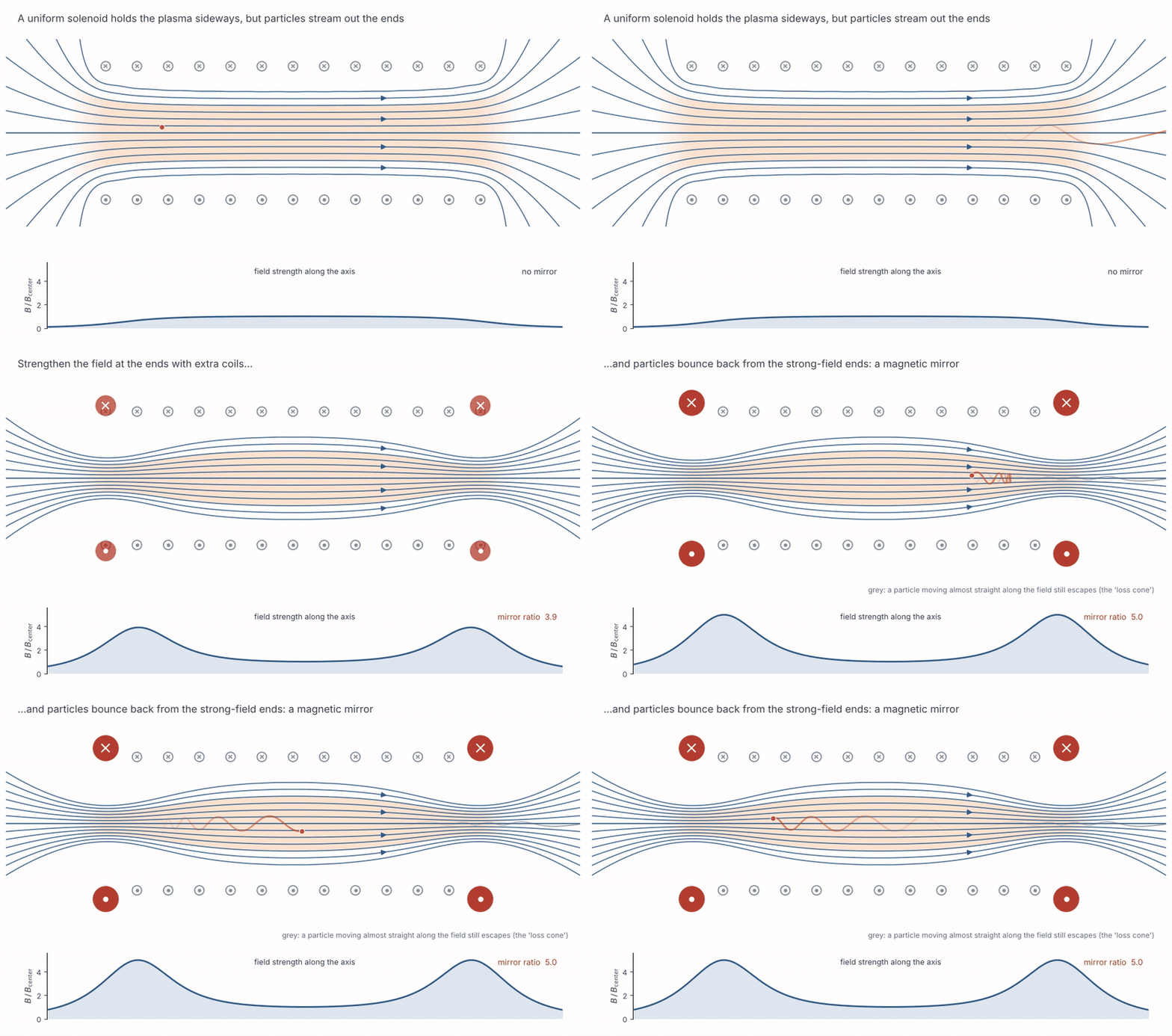
Alongside the Z-pinch, the magnetic mirror was one of the first proposed fusion concepts, with both American and Soviet efforts attempting to demonstrate sustained fusion in these easily configurable linear geometries. And like the Z-pinch, the first results were encouraging: Richard Post’s group at Livermore found that their plasma lasted noticeably longer with the mirror magnets switched on6. Unfortunately, the plasma has other ideas about being confined in a magnetic field which bows outward, a situation in which the curvature of the magnetic field and the pressure gradient of the confined plasma point in the same direction. With Lanyon, we can simulate a simple magnetic mirror and show exactly what goes wrong:
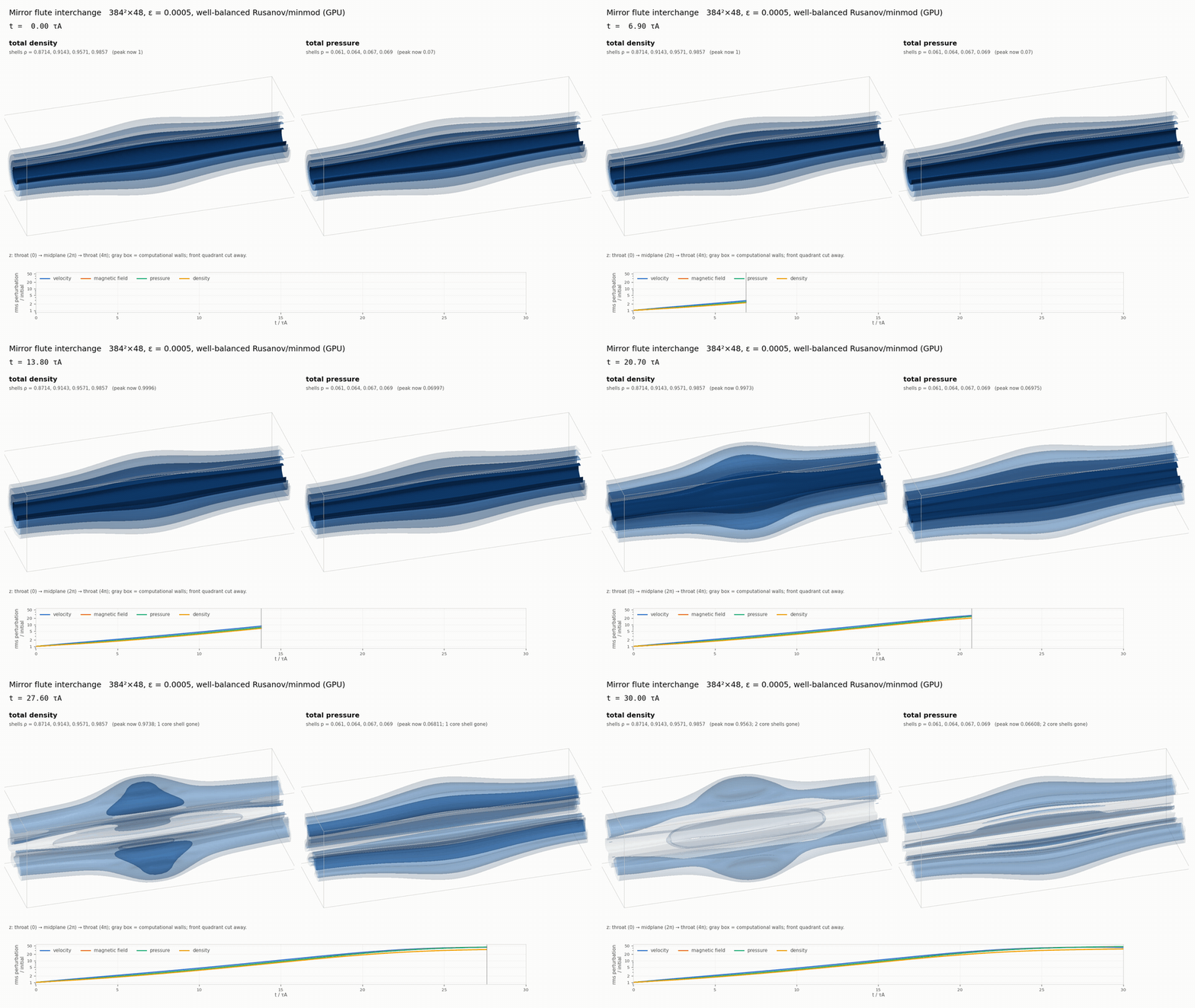
We use the same verified 3D MHD solver with hyperbolic divergence cleaning generated previously, but now with a new /simulate prompt requesting a magnetic mirror equilibrium (specifically a solution to the equation of MHD equilibrium known as the Grad-Shafranov equation) and a corresponding perturbation to this equilibrium. In fact, the flexibility of Lanyon is on full display in this particular simulation, because while we are currently formally verifying end-to-end a class of solvers that are more numerically diffusive (Lax fluxes with minmod limiting), we can utilize Lanyon’s neural layer to structure the simulation driver into a well-balanced scheme to minimize the effect of numerical diffusion on the equilibrium. In this case, Lanyon pre-computes the flux resulting from the discretization of our equilibrium, and then subtracts that flux from the total flux, such that our equilibrium is guaranteed to hold to machine precision while permitting full nonlinear evolution of the unstable plasma.
In our Lanyon simulation of this magnetic mirror, like before with the Z-pinch, we see that an initial imperfection in the plasma profile is magnified and disrupts the plasma profile. This disruption is caused by this alignment of the curvature of the magnetic field and the pressure gradient because in this case, the curvature of the field sets an effective gravity outwards. In effect, a particle streaming along a curved field line is like a car taking a curve: it feels a centrifugal push away from the center of curvature, which in the middle of a mirror means outward, toward the wall. But since simultaneously the pressure gradient means that a heavy fluid is sitting on top of a light fluid in this effective gravity, the plasma is only balanced, not stable. This instability, worked out in detail by Rosenbluth and Longmire (M. N. Rosenbluth and C. L. Longmire, Ann. Phys. 1, 120 (1957)) is the interchange, or flute, instability, for how it turns a column of plasma into a classical Greek column.
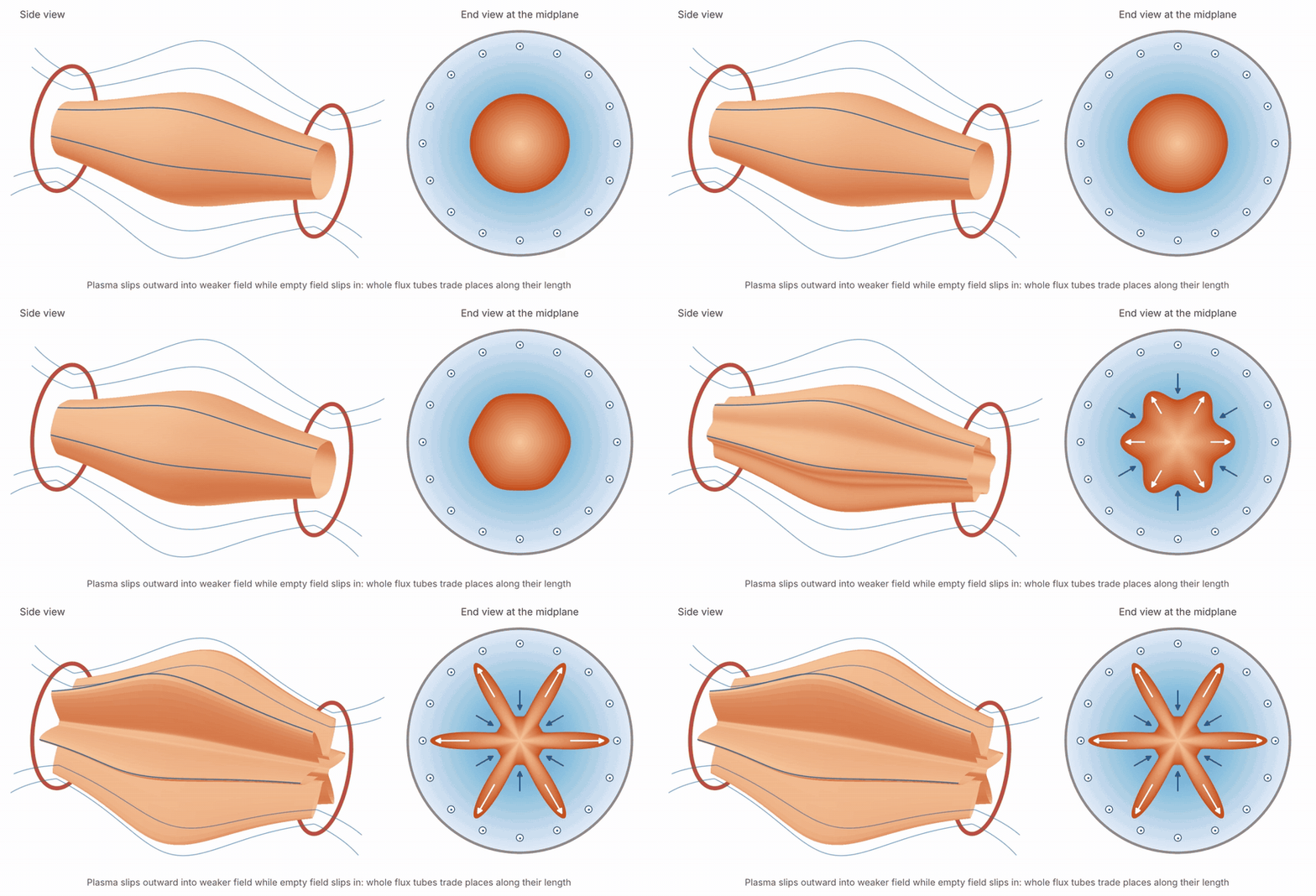
In exact analogy to the classical fluid instability known as the Rayleigh-Taylor instability, the perturbation to the plasma pushes outward in radius in the direction of this effective gravity, completely destroying the radial confinement. Lanyon can also make the same visualizations in the cross section of the mirror, showing the distortion from the equilibrium and the same structure as the interchange cartoon, but from a real simulation of the nonlinear MHD equations.
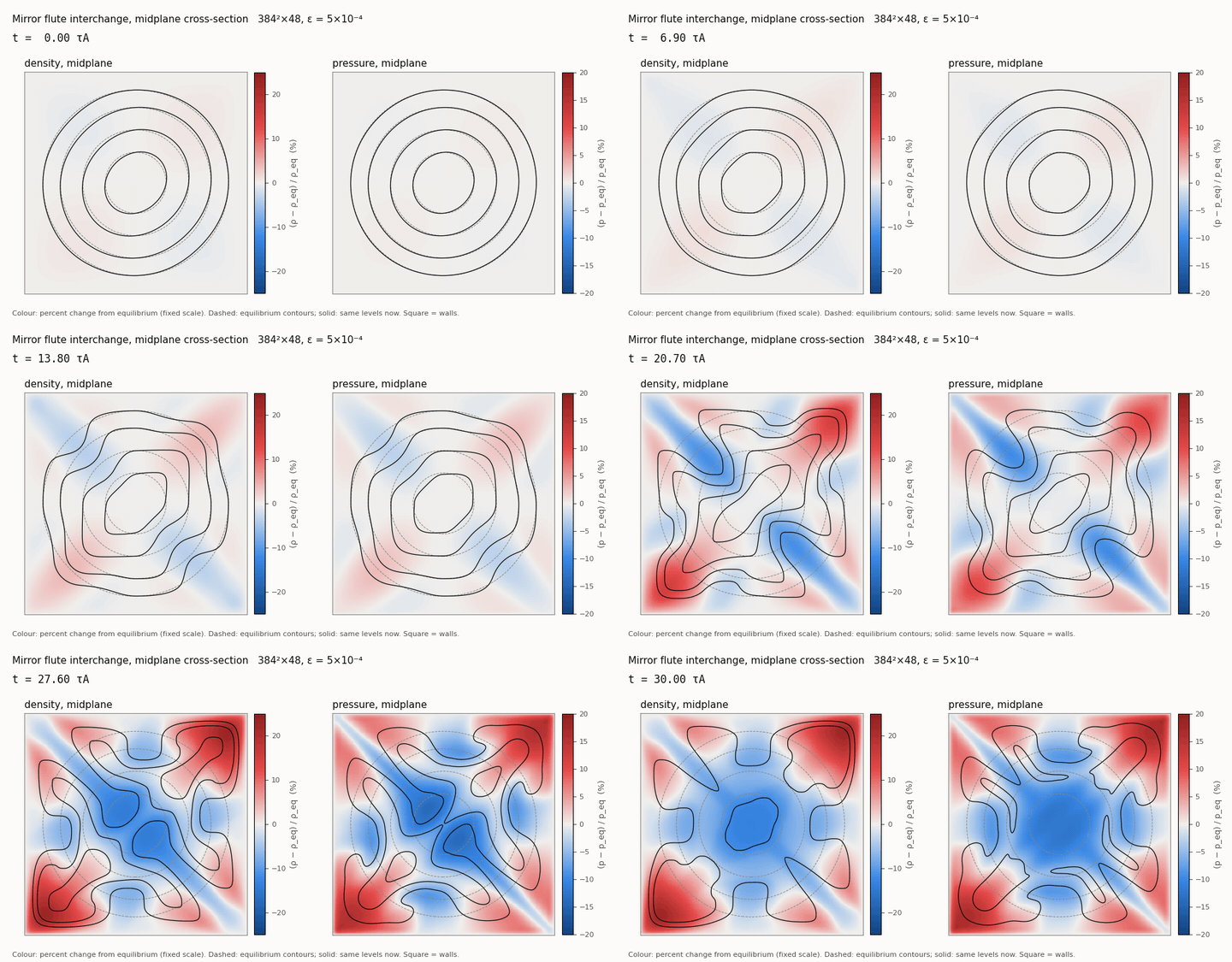
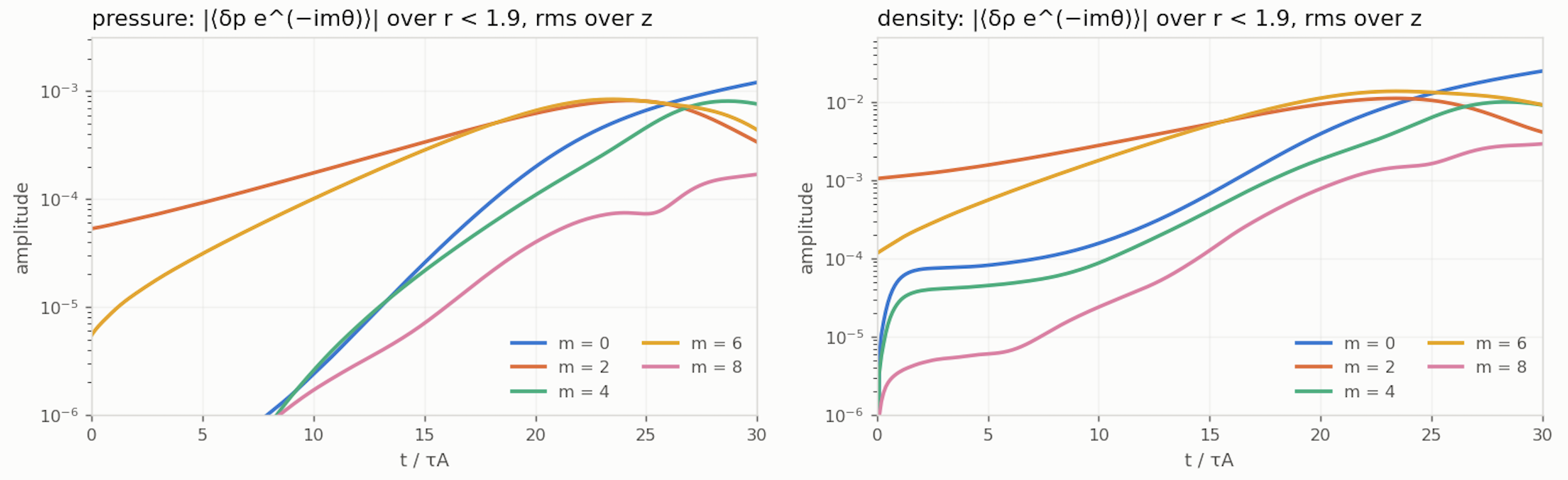
The time scale of this instability is comparably fast to what we observed in the Z-pinch, destroying the radial confinement of the plasma on a time scale of tens of Alfvén times7. Magnetic confinement devices have to operate at lower density than pinches because it would take at least 100T magnets to confine a $10^{24}/m^3$ plasma at fusion temperatures. Most forms of magnetic confinement usually operate closer to $10^{20}/m^3$. But at these lower densities, we need to hold on to the plasma for seconds to satisfy the Lawson criterion and instabilities this fast, on these Alfvénic and sonic time scales, grow in microseconds. Further, like with the Z-pinch, there is a whole zoo of unstable modes present that we can clearly identify using Lanyon’s neural layer in the post- processing of these simulations. Even if we work incredibly hard to remove imperfections and disturbances in our plasma, multiple unstable modes are present, they grow fast, and they will kill confinement in finite time. Holding on to the plasma with external magnets does not make attaining fusion any easier, at least, not without more shaping of the plasma than the nice, simple magnetic mirror configuration.
Peeling back the onion with Lanyon
Using Lanyon, we have autonomously produced verified solvers for the simulation of the conditions that demonstrated we had no easy path to fusion in the early years. Virulent, incredibly quickly growing instabilities on top of plasma equilibrium showed that holding onto a plasma long enough to satisfy the Lawson criterion was not going to be trivial. In future posts we will continue to peel back the onion of physics challenges which we have been repeatedly confronted by in our quest to bottle a star. We will look at modifications to linear devices to try to eliminate these MHD instabilities using shear and profile shaping, alternative configurations for which MHD is overly pessimistic, such as field-reversed pinches (FRCs), that nevertheless have deficiencies which more sophisticated formally verified solvers with Lanyon can reveal, and the development of the most performant fusion reactors to this day: tokamaks and stellarators, which exploit additional geometric shaping of the plasma and other symmetries to eliminate these fast growing instabilities, but not without introducing new challenges. For now, we conclude this post with our own excitement for what we are building here at Lanyon: a means to reliably simulate complex systems and analyze them in tremendous detail, revealing deep physics inside the intricacies of these systems. And we have more physics deep dives coming to show just how flexible and performant what we are building here at Lanyon is.
References and Footnotes
-
The energy density of our equal parts deuterium and tritium plasma, plus electrons, with total ion density $n$, all at temperature $T$, is
$$ W = 3nT $$per unit volume. The plasma will lose energy at a rate $W/\tau_E$ regardless of what is setting $\tau_E$, whether it is particle confinement or radiation or any of myriad of other processes.
Heating occurs via the produced alpha particles. If deuterium and tritium each have density $n/2$, we can compute the reaction rate per unit volume $\tfrac{1}{4}n^2\langle\sigma v\rangle$, where the reactivity $\langle\sigma v\rangle$ measures how likely two nuclei are to fuse at a given temperature. Since each reaction produces an alpha particle with energy $E_\alpha = 3.5$ MeV, so long as the amount of energy in the alphas exceeds the losses, we can achieve ignition:
$$ \frac{1}{4}\,n^2\langle\sigma v\rangle E_\alpha \;\geq\; \frac{3nT}{\tau_E} \qquad\Longrightarrow\qquad n\tau_E \;\geq\; \frac{12\,T}{\langle\sigma v\rangle\,E_\alpha}. $$$\langle\sigma v\rangle(T)$ climbs steeply with temperature as tunneling through the Coulomb barrier gets easier, then levels off, leading to the observed U shaped pattern for ignition as a function of temperature. ↩︎
-
Pollock J A and Barraclough S (1905) Proc. R. Soc. New South Wales 39 131 ↩︎
-
The world was abuzz when the ZETA (Zero Energy Thermonuclear Assembly) device, a Z-pinch twisted into a donut shape, measured neutrons in 1958 and claimed the neutrons were thermonuclear (Thonemann et al., Nature 181, 217 (1958); from the introduction: “The nuclear reaction-rates observed are not inconsistent with those expected from a thermonuclear process.”). In that very same issue of Nature though, a team at Los Alamos was showing that Z-pinch neutron yield was anisotropic in a manner inconsistent with sustained fusion (Hagerman & Mather, Nature 181, 226 (1958)), and results from Livermore and Berkeley soon followed which replicated the Los Alamos group’s findings (Anderson et al., Phys. Rev. 109, 612 (1958)). Plasma instabilities, not sustained fusion, were accelerating deuterium to high energies and giving a small yield of fusion neutrons from collisions with the colder deuterium background. ↩︎
-
The same physics haunts the other road to fusion that skips magnetic fields entirely: inertial confinement fusion. In an inertial confinement setup, lasers blast the outer surface of a fuel capsule, and like a rocket, the blown-off material drives the rest of the capsule inward, compressing the fuel fast enough to overcome the Coulomb barrier and achieve fusion. But here, this arrangement is unstable for the same reason the pinch is: any slight unevenness in the push gets amplified; in this case, a light fluid is pushing on a heavy one leads to the classical Rayleigh-Taylor instability. The National Ignition Facility (NIF) has recently gotten more fusion energy out of a capsule than the lasers put into the plasma (The Indirect Drive ICF Collaboration (H. Abu-Shawareb et al.), “Achievement of Target Gain Larger than Unity in an Inertial Fusion Experiment,” Phys. Rev. Lett. 132, 065102 (2024)), but suppressing the virulent instabilities in this setup was the same multi-decade endeavor magnetic confinement fusion has been fighting. ↩︎
-
At first glance, this statement may seem in contradiction to our earlier use of magnetic pressure to compress the Z-pinch, but any work done on the plasma must be through the electric field. We can see this statement by taking the MHD momentum equation and dotting the flow velocity $\mathbf{u}$ with the equation. We will then get that
$$ \mathbf{u} \cdot (\mathbf{J} \times \mathbf{B}) = -\mathbf{J} \cdot (\mathbf{u} \times \mathbf{B}) = \mathbf{J} \cdot \mathbf{E}, $$the traditional formula for the work done on the plasma by electromagnetic fields (and vice versa). So if there is no electric field, the energy of the plasma is conserved, as in the case of a magnetic mirror setup where there is only an imposed magnetic field. ↩︎
-
R. F. Post, Proc. 2nd UN Int. Conf. on the Peaceful Uses of Atomic Energy (Geneva, 1958), Vol. 32, p. 245. ↩︎
-
This Alfvén time is for an Alfvén wave traveling in the axial direction, though formally the interchange time scale is quoted in terms of the sound speed and the radius of curvature of the field lines. In this setup, it matters not; the time scale is fast. Much, much faster than the Lawson criterion says we need. ↩︎